
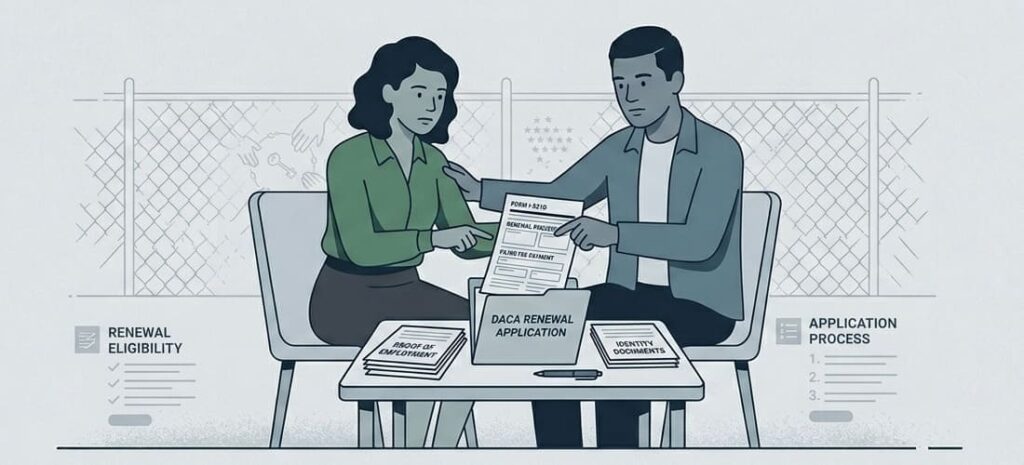
DACA — Deferred Action for Childhood Arrivals — is still active in 2026. Renewals are being accepted by USCIS. But the program is under renewed legal pressure, processing times have changed, and new background check requirements are in effect. If your DACA is expiring in the next 12 months, you need to act now.
What is DACA?
DACA is a federal program that protects people who came to the United States as children and have no documentation. It does not provide a path to a green card or citizenship, but it does provide two critical protections:
- Deferred action: Protection from deportation for a renewable two-year period.
- Work authorization: A valid Employment Authorization Document (EAD) that allows you to work legally.
DACA does not make you a lawful permanent resident. It is a temporary protection that must be renewed every two years.
Is DACA Still Active in 2026?
Yes — with limits. As of April 2026, USCIS is accepting renewal applications from people who have previously been approved. New first-time applications remain blocked by court orders.
The program continues to face legal challenges in federal courts. The most important ruling from the Fifth Circuit Court of Appeals found DACA unlawful, but a temporary stay allows renewals to continue while the case works its way to the Supreme Court.
Bottom line: If you currently have DACA, renew it. Do not wait.
Who Can Renew DACA in 2026?
You can renew if you meet all of the following:
- You previously received DACA and your most recent period has not been expired for more than a year.
- You have not been convicted of a felony, significant misdemeanor, or three or more other misdemeanors.
- You do not pose a threat to national security or public safety.
- You have continuously lived in the United States since June 15, 2007.
New Requirements for 2026 Renewals
USCIS has added stricter background checks for 2026 renewals. Specifically:
- More thorough review of criminal history, including arrests that did not result in convictions.
- Enhanced review of social media accounts in some cases.
- Stricter scrutiny of any travel outside the United States.
If you have any criminal history — even an arrest — speak with an immigration attorney before filing your renewal. What was not a problem in a previous renewal may be an issue now.
How to Renew DACA Step by Step
Step 1 — File 150 to 180 days before your expiration. USCIS recommends filing five to six months in advance. Do not wait until the last 60 days. If your EAD expires while your renewal is pending, you may lose your work authorization temporarily.
Step 2 — Gather your documents. You will need:
- Form I-821D (Consideration of Deferred Action for Childhood Arrivals)
- Form I-765 (Application for Employment Authorization)
- Form I-765WS (Worksheet)
- Copies of your previous EAD
- Two passport-style photos
- Filing fee: $495 (as of 2026)
Step 3 — Complete the forms carefully. Every question must be answered accurately. Inconsistencies between your current application and previous ones will generate a Request for Evidence (RFE) and delay your case significantly.
Step 4 — Submit by mail to the correct USCIS lockbox. DACA renewals are not processed online. Mail your package with USPS, UPS, or FedEx and keep your tracking number.
Step 5 — Attend your biometrics appointment. USCIS will send a notice for a fingerprinting appointment. Attend it. Missing it will cause your case to be denied.
Step 6 — Track your case. Use your receipt number at uscis.gov/casestatus to monitor your case.
How Long Does DACA Renewal Take in 2026?
Current USCIS processing times for DACA renewals range from 4 to 8 months. This is why filing early — 150 to 180 days before expiration — is essential.
What Happens If My DACA Expires Before My Renewal Is Approved?
If you filed your renewal while your DACA was still valid, USCIS will automatically extend your work authorization for up to 540 days while they process your case. You will receive an automatic extension notice. Keep this document with you at all times.
Frequently Asked Questions
Can I travel outside the US with DACA? No. DACA does not give you advance parole or permission to re-enter the United States after traveling abroad. Leaving the country without specific advance parole authorization will terminate your DACA and you will not be able to return.
Does DACA lead to a green card? No. DACA is not a path to permanent residency or citizenship. However, if you are married to a US citizen or have an employer who can sponsor you, you may have other legal options for permanent status. Speak with an attorney.
What if I have a traffic ticket or minor offense? Minor offenses may or may not affect your renewal. Do not assume they are irrelevant. Consult an attorney before filing.
What if I missed my renewal window? If your DACA has been expired for less than one year, you may still be able to file a renewal. If it has been expired for more than one year, you likely cannot. Contact an attorney immediately.
Your DACA protects your right to work and stay in the U.S. — but only if you renew it correctly and on time. If your DACA is expiring soon or you have any criminal history to discuss, call the Law Office of John V. Martine to schedule a case evaluation with an immigration attorney.
Call (256) 314-9142